For those of you unfamiliar with what Gestalt therapy is, I thought I would write a few quick lines by way of introduction.
There were a few things that attracted me to this way of working. I like the emphasis on working in the here and now. While the past contributes to who you are today, I am much more interested in your experience in the present and what it is like during our meeting now, than I am in your past or your future. So as a gestalt therapist I want to find out about your past to contextualise and better understand our meeting in the present. According to Gestalt theory, the healing happens most effectively in the live, here and now relationship.
Awareness is the cornerstone of gestalt. Some writers say that awareness is the goal of gestalt therapy. We are often not aware of aspects of who we are. Sometimes I might have feelings that perplex me or cause me difficulty in my interactions with others and with the world. By becoming aware, in other words, by really understanding myself, getting to know myself and ultimately accepting who I am, I will be able to cope with my life much more effectively.
Gestalt uses what we call experiments to help raise our clients awareness. These experiments are used to give the client a different perspective on their experience of themselves in the here and now. Some therapists may make use of drawing, writing, sculpting etc which aid the client in their exploration and experience of themselves. Perhaps the most well known experiment is the "two chair" or "empty chair" experiment. This is where the client imagines another person or an aspect of themselves sitting in an empty chair in the room. This sounded strange to me when I first heard about it but I've discovered that it can be a very powerful way of getting in touch with aspects of the self that are out of awareness.
I should also say that I don't use experiments in every session, or even with every client. Much of the work is listening, letting the client be really heard, and trying to understand my client's experience.
Perhaps I need to bring the subject back to my relationship with the wilderness and the main purpose of this blog. Over the course of my life I have loved being in the outdoors whether it be on a mountainside, by a river, a lagoon, a beach or in a desert. I have noticed that when I am in these places I feel different. Somehow I feel freer, better, more able to see myself and my life. When I return to my urban life, my perspective seems to have shifted in some way. So I have become curious as to what happens when I am "out there".
My theory is that, much like the gestalt experiment, I am given a different view of my own life. Sometimes this may relate to having some "me" time to think through a problem. Some space, physically and psychically. As I read back over these last few lines I notice that I've said, "I am given...", when actually it may be more true to say that "I give myself", and maybe that is part of what feels so good about being out there.
The wilderness then, it seems to me, has the potential to be a wonderful place for a gestalt experiment! A place where people can experience themselves in a different way, get to know different aspects of themselves.
Stay tuned!
Paul
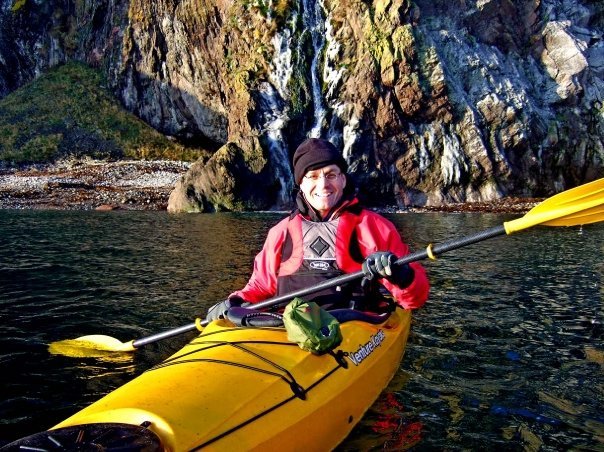
Winter Kayaking

Subscribe to:
Post Comments (Atom)


4 comments:
Hi Paul! I have een trying to figure out how to post a comment...
cause... I like the stuff you wrote in this last bit, and thought it rather more than something about gestalt, you are also saying quite a lot about yourself!
I thought we might start up a conversation about some research I have been planning that is not unlike wilderness therapy, in terms of interactions with locations being healing rather than just talking about them (to put it simply). www.scanmemories.org , bypass the detection, go to research and look at the locative therapy project. I don't know whether this is my main interest as yet, but this is what I have been thinking of in terms of the outdoors.
See what you think!
I can see some of the similarities. Particularly in taking therapy out of the confines of the therapy room and into the outdoors. Possibly facing some of the questions about creating boundaries without the physical boundaries of a building.
I am also interested in what different locations mean to different people. In the case of your project, the bereaved may be taken to a place meaningful because of it's link to the deceased loved one. So it would be loaded with meaning on a very personal level even if the client had no other affinity with the location.
To think about this from a Wilderness therapy perspective, the mountain (for eg) is a familiar place for me in many ways. As a location, mountains are very meaningful and evocative to me personally. However, this may be different for my client. There may be no personal connection, they may even be averse to the location. This is all material to work with in the here and now but I need to be careful about understanding the meaning others are making of the same place.
I'm fascinated to hear more of your thinking on location. Thanks for posting a comment!
Warm regards
Paul
Morning... yes I see what you mean about there being a boundary between the out- and indoors. One thing kept from the residential is how to manage the boundary tension between the inner and outer world- this place of transition. Which is I think how we create meaning fundamentally (and how we try to escape that, its easier), because a place is meaningful we manage to bring our inner world into the outside and establish a relationship. The connection with places becomes figural, and that somehow to me always feels good. It is also the underdog at the moment in this society, which somehow i have a soft touch for. For me its the sea and all its variations- but I can also easily look at other things in the environment and create meaning of where I am in my process. It helps. We don't take help from the outside enough. From nature, and people on the outside either. This fear is what scares me, and what I am interested in turning into excitement. With bereavement my clients can attain transpersonal realizations (one client whom I went to on location) which I think is allowing the fertile void, the unknown to emerge (Ruth Wolfet talks about this!). This I identify as a feeling of being at one with fear and excitement at the same time, another boundary tension.
Anyways- just brainstorming, hope you don't mind! There is an exercise described by Paul Goodman I believ which I find terribly exciting and tried out myself (related to boundary tensions), I could tell you about it if I find it.
Hi Julie,
I've been reminded of an association with place this week. If you check out my blog you'll see how I've had a reminder that memory of place can be jogged in a variety of ways.
This reminder has added another dimension to my experience of the 'now' and given me some ideas for my client work.
Take care,
Paul
Post a Comment