I was talking to Nick Ray recently about the African bush. It's something that we've both experienced close up and for extended periods. We agreed that after a while the whole feel and touch of the place really becomes ingrained, part of who we are. Then I said something that just slipped out naturally and seemed insignificant until Nick remarked on it. I was remembering what it was like to wake up in the bush after a night under the incredible stars of the African sky (something else I could go on about for hours!). I said something like, "...and waking up under a thorn tree and smelling the morning...". I was about to carry on but Nick smiled and stopped me.
I'd hadn't realised that just sitting there in my Wimbledon flat, I could smell the bush of northern Namibia. And how often do I smell the morning now? What do my mornings smell like now? The pleasant aroma of my morning coffee. The heavy industrial smell of diesel and petrol fumes as I stand at the bus stop. The rich smell of decaying vegetation on Wimbledon Common.
So this conversation, and memory, reminds me that there are many ways to experience the 'now'. Working holistically with clients I am often exploring their experience of the present including physical sensations, emotions, thoughts etc. But I've never considered the sense of smell. Perhaps it is not relevant in a stuffy winter counselling room. Yet, while working with clients in the Wilderness, it would seem like an ideal way of exploring the present. Another aspect of the vibrant, vivid now experience.
What do you smell in the morning?
Paul
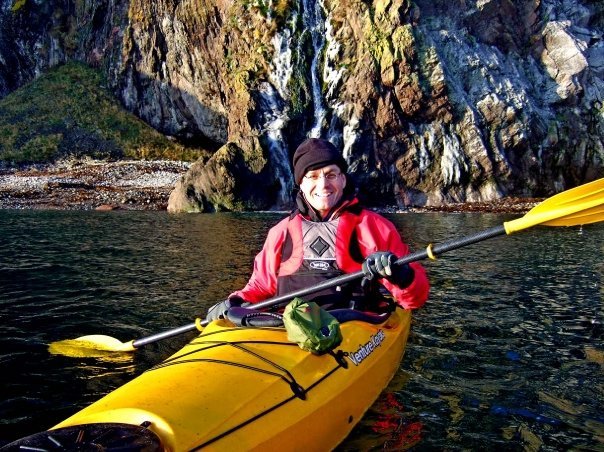
Winter Kayaking
Saturday, February 16, 2008

Friday, February 1, 2008
Something About Gestalt
For those of you unfamiliar with what Gestalt therapy is, I thought I would write a few quick lines by way of introduction.
There were a few things that attracted me to this way of working. I like the emphasis on working in the here and now. While the past contributes to who you are today, I am much more interested in your experience in the present and what it is like during our meeting now, than I am in your past or your future. So as a gestalt therapist I want to find out about your past to contextualise and better understand our meeting in the present. According to Gestalt theory, the healing happens most effectively in the live, here and now relationship.
Awareness is the cornerstone of gestalt. Some writers say that awareness is the goal of gestalt therapy. We are often not aware of aspects of who we are. Sometimes I might have feelings that perplex me or cause me difficulty in my interactions with others and with the world. By becoming aware, in other words, by really understanding myself, getting to know myself and ultimately accepting who I am, I will be able to cope with my life much more effectively.
Gestalt uses what we call experiments to help raise our clients awareness. These experiments are used to give the client a different perspective on their experience of themselves in the here and now. Some therapists may make use of drawing, writing, sculpting etc which aid the client in their exploration and experience of themselves. Perhaps the most well known experiment is the "two chair" or "empty chair" experiment. This is where the client imagines another person or an aspect of themselves sitting in an empty chair in the room. This sounded strange to me when I first heard about it but I've discovered that it can be a very powerful way of getting in touch with aspects of the self that are out of awareness.
I should also say that I don't use experiments in every session, or even with every client. Much of the work is listening, letting the client be really heard, and trying to understand my client's experience.
Perhaps I need to bring the subject back to my relationship with the wilderness and the main purpose of this blog. Over the course of my life I have loved being in the outdoors whether it be on a mountainside, by a river, a lagoon, a beach or in a desert. I have noticed that when I am in these places I feel different. Somehow I feel freer, better, more able to see myself and my life. When I return to my urban life, my perspective seems to have shifted in some way. So I have become curious as to what happens when I am "out there".
My theory is that, much like the gestalt experiment, I am given a different view of my own life. Sometimes this may relate to having some "me" time to think through a problem. Some space, physically and psychically. As I read back over these last few lines I notice that I've said, "I am given...", when actually it may be more true to say that "I give myself", and maybe that is part of what feels so good about being out there.
The wilderness then, it seems to me, has the potential to be a wonderful place for a gestalt experiment! A place where people can experience themselves in a different way, get to know different aspects of themselves.
Stay tuned!
There were a few things that attracted me to this way of working. I like the emphasis on working in the here and now. While the past contributes to who you are today, I am much more interested in your experience in the present and what it is like during our meeting now, than I am in your past or your future. So as a gestalt therapist I want to find out about your past to contextualise and better understand our meeting in the present. According to Gestalt theory, the healing happens most effectively in the live, here and now relationship.
Awareness is the cornerstone of gestalt. Some writers say that awareness is the goal of gestalt therapy. We are often not aware of aspects of who we are. Sometimes I might have feelings that perplex me or cause me difficulty in my interactions with others and with the world. By becoming aware, in other words, by really understanding myself, getting to know myself and ultimately accepting who I am, I will be able to cope with my life much more effectively.
Gestalt uses what we call experiments to help raise our clients awareness. These experiments are used to give the client a different perspective on their experience of themselves in the here and now. Some therapists may make use of drawing, writing, sculpting etc which aid the client in their exploration and experience of themselves. Perhaps the most well known experiment is the "two chair" or "empty chair" experiment. This is where the client imagines another person or an aspect of themselves sitting in an empty chair in the room. This sounded strange to me when I first heard about it but I've discovered that it can be a very powerful way of getting in touch with aspects of the self that are out of awareness.
I should also say that I don't use experiments in every session, or even with every client. Much of the work is listening, letting the client be really heard, and trying to understand my client's experience.
Perhaps I need to bring the subject back to my relationship with the wilderness and the main purpose of this blog. Over the course of my life I have loved being in the outdoors whether it be on a mountainside, by a river, a lagoon, a beach or in a desert. I have noticed that when I am in these places I feel different. Somehow I feel freer, better, more able to see myself and my life. When I return to my urban life, my perspective seems to have shifted in some way. So I have become curious as to what happens when I am "out there".
My theory is that, much like the gestalt experiment, I am given a different view of my own life. Sometimes this may relate to having some "me" time to think through a problem. Some space, physically and psychically. As I read back over these last few lines I notice that I've said, "I am given...", when actually it may be more true to say that "I give myself", and maybe that is part of what feels so good about being out there.
The wilderness then, it seems to me, has the potential to be a wonderful place for a gestalt experiment! A place where people can experience themselves in a different way, get to know different aspects of themselves.
Stay tuned!
Subscribe to:
Posts (Atom)


